
Renovating vs Rebuilding: Which Makes More Financial Sense

For many Sydney homeowners, there comes a point when your home no longer suits your lifestyle. Maybe your family has grown, the layout feels outdated, or the house simply needs more work than you expected.
The big question then becomes: Should you renovate your existing home or start fresh with a rebuild?
The answer isn't always straightforward. While cost is often the first thing homeowners consider, the cheapest option upfront isn't always the most cost-effective in the long run.
Here's what you should consider before making one of the biggest property decisions you'll ever face.
Start by Looking Beyond the Price Tag
It's easy to compare the estimated cost of a renovation with the cost of a new build. However, focusing only on the initial budget can be misleading.
The real financial picture includes:
Ongoing maintenance costs
Energy efficiency
Future repair expenses
Property value
How long the home will meet your family's needs
Sometimes spending more now can save tens of thousands over the next 20 years.
When Renovating Makes Financial Sense
Renovating can be an excellent investment when the home's structure is sound and you're happy with its location and overall layout.
A renovation often makes sense if:
The foundation and structural frame are in good condition.
You only need to modernise kitchens, bathrooms or living areas.
You want to improve functionality without dramatically increasing the home's size.
Local council restrictions make rebuilding difficult.
You're preserving character features that add value.
Many well-planned renovations deliver excellent returns while allowing homeowners to remain in the neighbourhood they love.
When Rebuilding May Be the Smarter Investment
Sometimes a renovation seems cheaper at first, but hidden issues quickly change the equation.
Older homes can hide problems such as:
Structural damage
Termite infestation
Ageing plumbing
Outdated electrical systems
Poor insulation
Water damage
Asbestos
Non-compliant building work completed decades ago
By the time these issues are addressed, renovation costs can increase significantly.
In these situations, rebuilding often provides better long-term value because you're starting with an entirely new home built to today's standards.
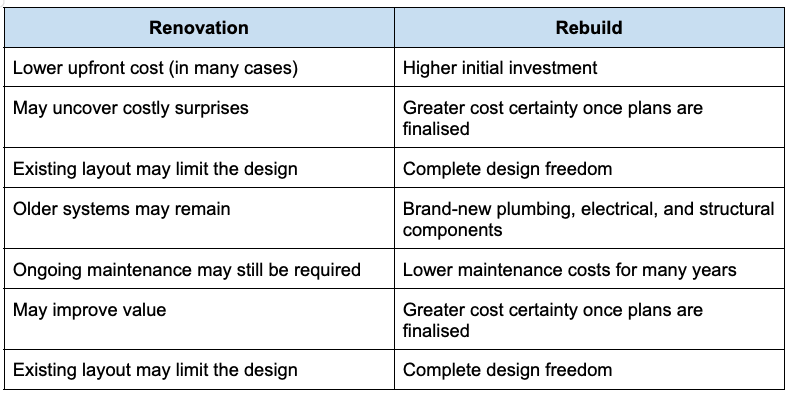
Compare the Long-Term Costs
Here's a simple comparison to help guide your decision.
Think About Energy Efficiency
One often overlooked financial benefit of rebuilding is reduced running costs.
A new home can include:
Better insulation
Double glazing
Modern roofing systems
Energy-efficient lighting
Solar-ready design
Improved ventilation
High-performance windows and doors
These features can significantly reduce heating and cooling costs while making your home more comfortable throughout the year.
Consider Your Future Plans
Financial sense isn't just about today's budget—it's about where you'll be in 10 or 20 years.
Ask yourself:
Will this home still suit our family as it grows?
Are we planning to stay long term?
Could we add value through better design?
Will future renovations still be needed after this project?
Are we investing in a forever home or preparing to sell?
The right solution is the one that aligns with your long-term goals, not just your immediate budget.
Don't Forget the Hidden Costs
Both options come with expenses that aren't always obvious.
Renovations may involve:
Temporary accommodation
Unexpected structural discoveries
Design compromises
Working around existing services
Rebuilds may involve:
Demolition costs
Additional council approvals
Longer construction timelines
Temporary accommodation during the build
Understanding these costs early helps you avoid budget surprises later.
The Importance of Professional Advice
Every property has its own opportunities and challenges.
An experienced builder can assess:
The condition of your existing home
The likely cost of hidden repairs
The feasibility of extending or renovating
Whether rebuilding would provide better long-term value
Making the right decision starts with accurate information—not assumptions.
Final Thoughts
There's no one-size-fits-all answer when deciding between renovating and rebuilding.
If your existing home has good bones and only needs modernisation, a renovation could deliver excellent value.
However, if you're constantly repairing an ageing home, dealing with structural issues, or struggling with an outdated layout, rebuilding may be the smarter financial investment over the long term.
The best decision is one that's based on your property's condition, your family's future needs, and realistic construction costs—not just the lowest upfront quote.
At Prescom Constructions, we help Sydney homeowners weigh up both options honestly. Whether you're considering a renovation, an extension, or a complete rebuild, we'll provide practical advice and quality workmanship to help you make the right investment for your future.
Thinking about renovating or rebuilding? Contact Prescom Constructions today to discuss your property and discover which option makes the most financial sense for your home.